What Ghana’s border communities teach practitioners about livelihoods, dialogue and early action, and what the evidence still cannot tell us about community resilience against violent extremism.
Executive Summary
More than 76 per cent of terrorist attacks worldwide in 2025 took place within 100 kilometres of an international border, up from just under 60 per cent in 2007. Ghana’s northern districts are that kind of place. They face Burkina Faso, absorb most of the displacement from its conflict, and carry the pressure before anywhere else in Ghana.
Prevention work now runs through those same districts. The PERCH project, run by UNDP and IOM with United States funding across five communities in the Upper East and Upper West, has trained over 500 women and young people and 54 Peace Champions, set up savings associations in all five communities, and installed solar water systems serving 2,000 people. Two of those communities, Tarikom and Zini, are also where the Ghana Refugee Board and UNHCR receive Burkinabe arrivals: same villages, largely separate funding lines.
The open question is no longer whether economic inclusion supports prevention. It is whether these programmes are connected enough, and funded long enough, to outlast their project cycles. The National Peace Council’s DRIVE Index pilot ran from October 2025 to June 2026 in northern border communities. Until it reports, prevention spending here is being allocated without a community-level resilience baseline.
The design question is not whether livelihoods or dialogue matter. It is whether they are connected, locally owned and funded long enough to become institutions.
Background: A border, not a Buffer
Northern Ghana’s border districts manage several pressures at once. Climate stress on farming and grazing. Farmer-herder tension over land and water. Disputes that go unmediated. Thin livelihood options. A steady movement of people across the frontier.
The displacement figures need care, because the most quoted one is old. UNHCR’s country page still gives approximately 17,300 registered refugees and asylum-seekers as at December 2024. That has been overtaken: UNDP, citing UNHCR and the Ghana Refugee Board, put the total above 20,000 in December 2025. At World Refugee Day events in Bolgatanga in June 2026, the Ghana Refugee Board’s Upper East Regional Coordinator, Sika Agbesi, said 5,576 refugees had been registered in that region alone, with 2,380 relocated to the Tarikom camp. Arrivals are hosted at Tarikom, Zini, Fielmo, Bansi and Issakatinga.
In a gazette published on 30 January 2025, Ghana granted prima facie refugee status to Burkinabe arrivals with no cut-off date, extending documentation and legal recognition. Displacement is not a security category. Host communities and displaced people need the same things: protection, services, and reasons to build relationships rather than compete for them.
Problem Analysis: Community Resilience against Violent Extremism
Poverty, unemployment, displacement, ethnicity and geography do not produce violent extremism on their own. Most people living with real hardship reject violence and defend their communities. UNDP’s Journey to Extremism in Africa (2023) identifies worsening economic conditions and poverty among the main factors drawing individuals in, but is clear that hardship alone does not do it.
Risk rises when pressures converge and stay unresolved: exclusion that persists across years, disputes with no route to mediation, low confidence in institutions, and few credible ways to improve one’s position. Which means the first warning signs are social rather than security-related. A land dispute nobody mediates. A community that has stopped reporting because nothing happened the last time it did.
Ghana’s own institutions reached a similar conclusion. A national forum in March 2026 reviewed the 2019 National Framework for Preventing and Countering Violent Extremism and Terrorism, drawing on consultations across 11 of Ghana’s 16 regions. Its recommendations centred on institutional coordination, stronger early warning and response, and community resilience. The framework needed review because implementation gaps had opened after 2019: seven years of national policy is not seven years of local delivery.
Research Findings
The geography of terrorism has inverted
In 2007 the Sahel accounted for under one per cent of global terrorism deaths. In 2025 it accounted for more than half. The Global Terrorism Index 2026 recorded 5,582 deaths worldwide across 2,944 incidents, down 28 per cent, with the improvement concentrated in regions that were never the centre of the problem. Over 76 per cent of attacks occurred within 100 kilometres of an international border. Ghana’s northern frontier is one of them.
A falling death toll can mask rising lethality
Burkina Faso’s terrorism deaths fell 45 per cent in 2025, to 846 from 1,532, the largest single-country decline in the world. Deaths per military and police incident rose from 10.5 to 18.9 over the same period, as armed groups shifted to fewer, heavier strikes and to blockade. The headline improved. The pressure on the border did not. The index’s own reading is that security gains without governance change amount to a temporary truce.
The threat is moving toward the coast
The 2026 index records terrorism spreading from the landlocked Sahel toward coastal West Africa. Benin recorded a significant rise in deaths in 2025 and deployed 3,000 soldiers along its northern borders. Ghana has seen no comparable escalation, which is the point: here, prevention is still cheaper than response.
Resilience is uneven at community level
When the DRIVE methodology was piloted in Cote d’Ivoire’s border regions, resilience varied between neighbouring communities, shaped by trust in institutions, the inclusion of youth and women, the quality of services and civilian-security relations. District averages hide that variation, so programming built on district data will miss the village actually at risk.
Case Studies
PERCH: Upper East and Upper West, Ghana
Across Zini and Kwapun in the Upper West and Sapeliga, Widnaba and Tarikom in the Upper East, over 500 women and young people have been trained in dry-season gardening, livestock rearing, shea processing, rice milling, tailoring and carpentry.
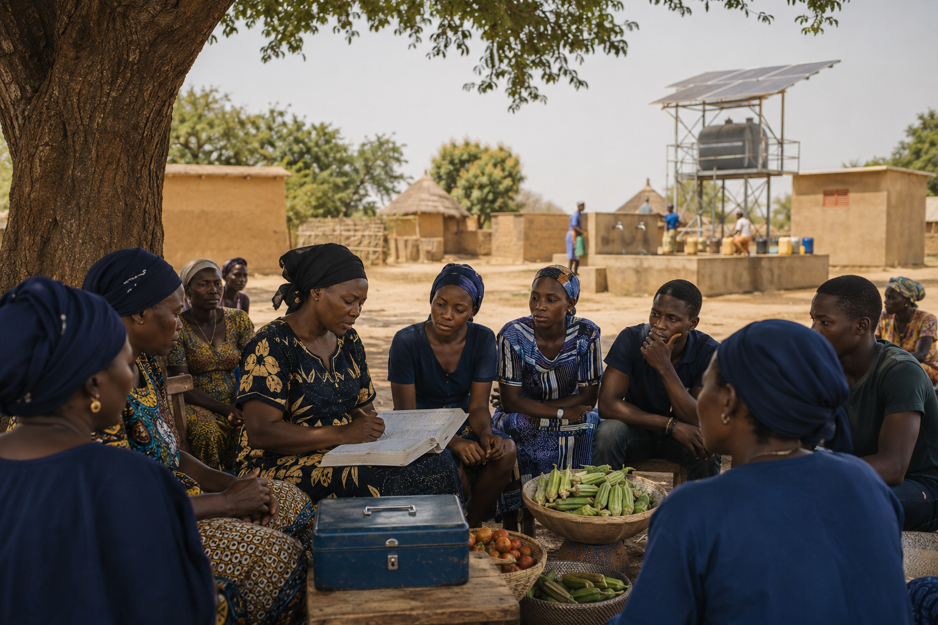
Savings and loan associations in all five communities mobilised over GHS 45,000, roughly USD 4,000, in three months to September 2025. The sum is small. What it does is not: it puts members in a room weekly with a shared financial stake and a reason to resolve disagreements rather than walk away.
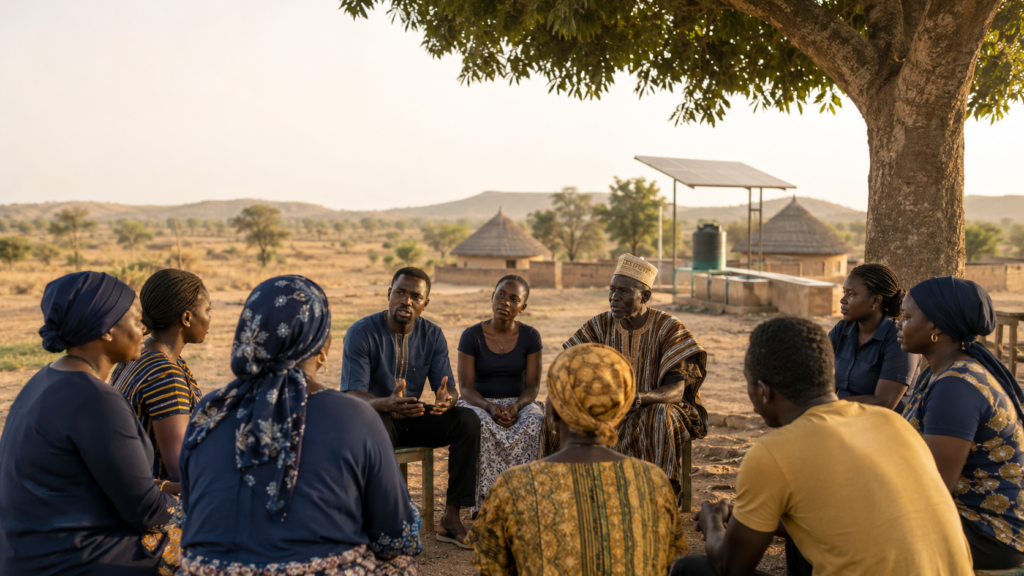
Fifty-four Peace Champions from traditional leadership, women’s groups, youth and refugee communities are building Community Dialogue Platforms for early warning and mediation. Solar water systems serve 2,000 people across the five communities, reducing competition over water and returning hours to the women and girls who fetched it.
Nsunia: Bole District, Savannah Region
In September 2024, under the separate Atlantic Corridor initiative, women and young people in Nsunia received ten energy-saving stoves, five shea-nut drying platforms and two cassava graters. What matters is what they do with them. Women parboil and dry shea nuts on the platforms to prevent contamination and hold quality, which protects the price. The stoves cut fuelwood use, so pickers spend less of the day searching for wood.
Nsunia has a primary school and no health facility, and depends on neighbouring Mandari for care. The equipment changed none of that. It changed the return on a day’s work, a narrower claim than prevention programming usually makes and a more defensible one.
What this means in Practice
For practitioners, the design unit is the community, not the district. Two villages twenty kilometres apart can hold sharply different levels of trust in the same institution, and that difference decides whether an early warning system receives anything. For government institutions, the corollary is that reporting only holds where response follows. A community that reports and sees nothing happen will not report again.
For donors, the funding cycle is the risk. Savings groups, dialogue platforms and peace committees take longer to become durable than most grant periods run. UNDP’s own recommendation after PERCH was to link Community Dialogue Platforms to national early warning systems and Peace Councils, a step that falls after the launch event and after most reporting deadlines.
Six Priorities
- Fund prevention as a connected system. Donors should commit multi-year support linking livelihoods, dialogue, mediation, early warning and referral in the same communities. Short projects produce outputs; institutions that survive need continuity.
- Pair economic support with participation. A livelihood grant will not resolve exclusion. Implementing partners should pair enterprise support with mentoring and explicit links to local governance, and budget for the mentoring rather than treat it as a by-product.
- Institutionalise dialogue platforms before the project closes. Community Dialogue Platforms need defined membership, safeguarding rules, referral pathways and a formal link to Regional Peace Councils and district assemblies, and the Councils should hold that link, not implementing partners.
- Centre women, young people and marginalised groups in decisions. Participation means identifying risks, designing interventions, managing resources and assessing results, not attendance. A programme that cannot name the decisions they made has not done it.
- Protect dignity and consent. Communications should not present northern communities, refugees, Fulbe people or unemployed youth as threat categories. Identifiable stories and images require documented informed consent, and detail that identifies someone without naming them carries the same duty.
- Measure resilience, not activity counts. Track whether disputes are resolved before escalation, whether residents trust reporting channels, and whether livelihoods survive twelve months after support ends. When DRIVE reports, its indicators should replace current proxies.
Where this leaves us
The evidence from these border districts points the same way each time: economic inclusion, trusted dialogue, local mediation and early action reinforce one another, and any one alone underperforms. What it does not yet show is durability. Ghana documents what prevention programmes deliver and very little about what survives them. DRIVE will close part of that gap this year. The rest depends on whether the platforms and savings groups built since 2024 are still working in 2028, and whether anyone is funded to find out.
A question for practitioners in these districts: what has actually survived the end of a project in your programme, and what did you do to keep it? Tell us in the comments.
Sources and Further Reading
Primary and authoritative sources are linked contextually above and listed here for editorial verification.
- Institute for Economics & Peace — Global Terrorism Index 2026 (March 2026)
- UNDP Ghana — Building Resilience and Peace Across Borders: Lessons from Ghana’s PERCH Project (10 December 2025)
- UNDP Ghana — Enhancing Sustainable Livelihood for Women and Youth in Nsunia Community
- UNDP Ghana — Ghana Reviews National Framework to Strengthen Prevention of Violent Extremism (March 2026)
- Ghana News Agency — Ghana reviews counter-terrorism framework amid regional extremism threats (26 March 2026)
- National Peace Council — National Peace Council and Partners Launch DRIVE Index (February 2026)
- Graphic Online — National Peace Council launches index against violent extremism (4 February 2026)
- Citi Newsroom — Over 10,000 Burkinabe refugees flee to Ghana amid Sahel crisis (21 June 2026)
- UNHCR — Ghana country page
- UNDP — Journey to Extremism in Africa: Pathways to Recruitment and Disengagement (2023)