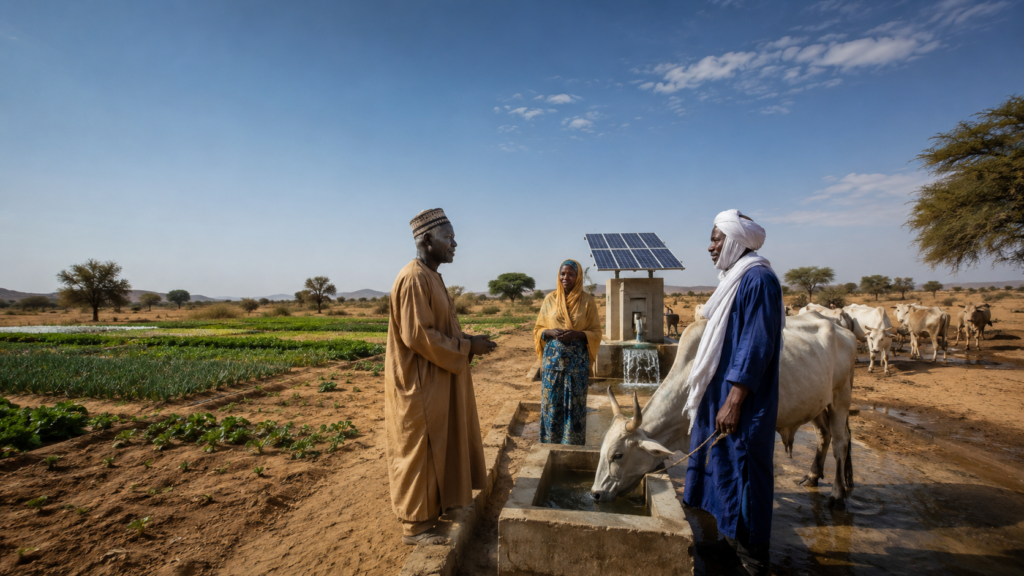
Climate change and conflict in Africa connect through resource competition, displacement and weak governance. The evidence supports integrated climate-peace programming—but not simple climate-causes-war claims.
Executive summary
Farmer–herder violence in Nigeria has caused mass fatalities and displacement. A widely cited 2018 International Crisis Group comparison found it was then six times deadlier than Boko Haram, and ACCORD revisited the claim in October 2025. The comparison should not be treated as a current annual ranking, but it still exposes a funding problem: climate stress sits in environment budget lines while security money follows insurgency.
Climate change does not start conflicts. It loads pressure onto places already carrying weak governance, contested land tenure and long marginalisation, and it does so faster than institutions adapt. The African Union Peace and Security Council held its first session dedicated specifically to climate impacts in the Sahel and Lake Chad Basin at its 1344th meeting on 4 May 2026, and recognised climate change as a threat multiplier that intensifies competition over natural resources, disrupts livelihoods and contributes to displacement.
Climate is a threat multiplier: it changes the pressure on land, water and livelihoods. Governance determines whether that pressure is negotiated, absorbed or weaponised.
For practitioners the implication is narrower and more awkward than the communiqué language suggests: programmes that treat adaptation and mediation as separate workstreams are addressing one pressure at a time in places where the pressures compound. On our reading of the current evidence, the sector’s confidence about what works in climate-security programming runs ahead of what has been measured. Designing around that gap, openly, beats writing around it.
Background
The Sahel is warming at roughly 1.5 times the global average, with projections of at least 2°C by 2040. In the tri-border area shared by Burkina Faso, Mali and Niger, that arrives as failed rains, shortened grazing seasons and land that supports fewer people than it did a decade ago, in communities already managing armed violence.
Lake Chad is the clearest warning against a single-cause story. UNEP documents a dramatic contraction in open water from about 25,000 km² in the 1960s to less than one tenth of that area by the 2000s, driven by drought, irrigation and climate variability together. The lake fluctuates, so the familiar claim that 90 per cent has ‘disappeared’ should not be read as a fixed present-day measurement. The wider basin supports tens of millions of people. Fishing grounds moved, grazing corridors narrowed, and armed groups exploited livelihoods already under pressure.
Where the pressure lands
Across West Africa, the sharpest edge is the farmer-herder relationship. In Senegal, average annual rainfall over the past three decades has run about 27 per cent below the 1951–1980 average, and farmers report they can no longer predict when the rains will start or stop. Herders on centuries-old routes now travel further south, arriving during harvest rather than after it. In January 2025, a dispute over grazing in the Thiès region ended with a 60-year-old farmer killed. Northern Ghana shows the same collision along the Black Volta River corridor. Research published in April 2025 identified competition over land and water, encroachment into conserved areas, and mutual misreading of land-use practice as the leading drivers of conflict between farmers, pastoralists and conservationists. That coexistence was already fragile before climate stress and decades of underinvestment were added to it.
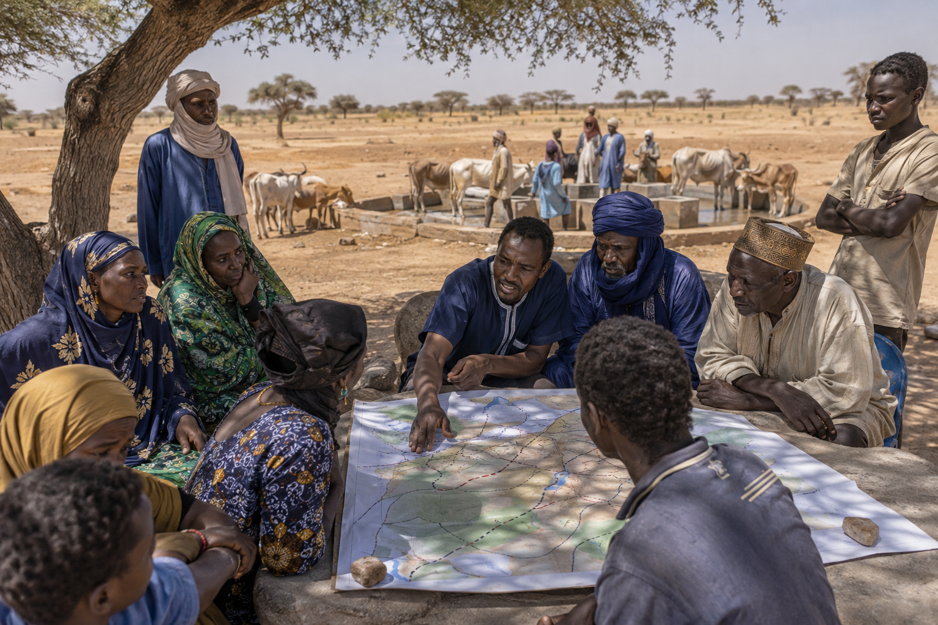
Displacement transmits the pressure onward. In Uganda’s West Nile, recurring drought has lowered water tables and cut borehole output across refugee settlements. Daily Monitor reported in June 2026 that in Rhino Camp, which hosts more than 202,000 refugees and asylum seekers across Madi-Okollo and Terego districts, solar pumps that once ran all day now yield a trickle, and households organise their mornings around queues at water points that used to take minutes. What follows is competition over water, cultivable land, firewood and thatching materials, between people who are all short of the same things.
Climate change and conflict in Africa: what the research shows
A June 2026 fact sheet from the Norwegian Institute of International Affairs and SIPRI sets out three pathways by which climate stress shapes security risk in the Lake Chad Basin: livelihood disruption that weakens local economies and sharpens competition; displacement and cross-border movement that transfer pressure onto host communities; and armed group exploitation of natural resource economies.
An evaluation of programmes in Uganda’s Karamoja sub-region and north-west Kenya, published in March 2026, found that households taking part in inclusive, climate-informed natural resource management came through climate and conflict shocks better than non-participants, with measurable gains in women’s participation in decision-making.
What the evidence does not yet show. That evaluation compares participants with non-participants; it is not a randomised design, and self-selection into programmes is a live limitation. The Nigerian mortality comparison rests on a 2018 baseline that has not been systematically updated. And the Lake Chad regional strategy assessment reports a political achievement, not a measured reduction in violence. We have strong evidence that climate stress amplifies existing vulnerability, and much weaker evidence about which interventions reduce violence and by how much. Programme design should say so rather than borrow certainty the literature has not earned.
Case studies
Lake Chad Basin. In 2018, Cameroon, Chad, Niger and Nigeria adopted a Regional Strategy for the Stabilisation, Recovery and Resilience of Boko Haram–affected areas, alongside the Multinational Joint Task Force. An assessment published in June 2026 found the first phase achieved something real but narrow: it brought political, humanitarian, development, civil society and community actors into a shared reading of the problem, and connected communities to provincial, national and regional authorities. Climate received far less attention in implementation. Agricultural productivity kept falling, youth unemployment kept rising, and women and girls absorbed the difference in hours spent sourcing water, food and fuel.
Burkina Faso, Mali and Niger. These three are developing the world’s first National Strategic and Action Plans on Climate, Peace and Security. Between September 2023 and November 2025, consultations ran across more than 60 entities, including civil society, youth representatives, religious leaders and women’s groups. Burkina Faso estimates 500 billion CFA francs (about USD 820 million) for delivery over 2026–2030, part from national budget, the rest from partners and climate finance. What distinguishes it is structural: a joint ministerial agreement between the Ministry of Economy and the Ministry of Environment, which is what stops a climate-security plan from living permanently inside the environment ministry.
Jibia, Katsina State. On 10 June 2026, the Katsina State Government and UNDP commissioned 152 housing units for displaced families, a Climate Peace Hub, a rehabilitated cattle market and a solar mini-grid, backed by Germany through GIZ and by Norway. The cattle market matters as much as the housing: it restores a trading function the conflict removed. UNDP Nigeria Resident Representative Elsie G. Attafuah said the investments were “designed to support that resilience,” and that the housing units provide “more than shelter.” The state supplied land, boundary walls, a school and a place of worship, co-financing that determines whether any of it survives the project cycle.
What this means in practice
For practitioners: adaptation, livelihood support and natural resource governance belong inside peacebuilding design, not adjacent to it. A borehole programme with no dispute-resolution mechanism attached will produce a new thing to fight over. We took up the community-level side of this question in our earlier article, Preventing Violent Extremism Through Community Resilience.
For national institutions: the AU’s May 2026 communiqué is explicit that these risks cross borders. So do pastoral routes and watersheds. The Burkinabè joint ministerial agreement is the replicable part, not the budget figure.
For donors: the funding cycle is the binding constraint. Results come from pairing technical adaptation capacity with real influence over local governance, and that pairing takes longer than a two-year grant.
Six priorities
- Fund adaptation from security budgets, not only environment budgets. Land restoration and water management in border zones are prevention spending, and where they sit in the budget determines their scale.
- Attach mediation to every livelihood intervention. Pair enterprise support with dispute-resolution platforms and a link to local authority. Economic inclusion alone does not settle competing claims.
- Measure whose input changes outcomes. Women, youth and marginalised groups need decision-making power, not attendance. Track which proposals were adopted and by whom, not headcount.
- Resource cross-border coordination properly. The Lake Chad Basin Commission structure works at the political level and is under-resourced at the implementation level. Fund the second.
- Align climate-peace plans with NDCs. National plans that sit outside Nationally Determined Contributions and development frameworks lose their finance route.
- Commit for longer than the shock cycle. Short projects deliver outputs. Reduced violence, where it happens, follows sustained presence.
Where this leaves us
The direction of the evidence is consistent. Climate stress deepens existing vulnerability, sharpens competition over resources, and widens the space armed groups operate in. Where communities hold inclusive governance, working dialogue platforms and viable livelihoods, they absorb the pressure. Where those are missing, it converts into violence. Which combination of interventions works best, and how quickly, is not yet established.
A question for practitioners: is your programme treating climate adaptation as a peacebuilding investment or as a separate track? Most budget lines still say the second. Most field evidence says the first.
Related reading: Preventing Violent Extremism Through Community Resilience, which covers how prevention holds or fails at community level.
Sources and further reading
Primary and authoritative sources are linked contextually above and listed here for editorial verification.
- African Union Peace and Security Council — Communiqué of the 1344th Meeting on climate impacts in the Lake Chad Basin and Sahel (4 May 2026)
- ACCORD — Climate Change as a Threat Multiplier: Environmental Stress and Violent Conflict in Northern Nigeria (30 October 2025)
- International Crisis Group — Stopping Nigeria’s Spiralling Farmer-Herder Violence, Report No. 262 (2018)
- Associated Press — In Senegal, climate change is adding to historic tension between farmers and herders (16 December 2025)
- Environment, Development and Sustainability — Pathways to farmer-pastoralist-conservationist conflict resolution along the Black Volta River corridor (2025)
- Daily Monitor — Climate stress fuels conflict between locals and refugees (26 June 2026)
- UNEP — The tale of a disappearing lake
- NUPI/SIPRI — Climate, Peace and Security Fact Sheet: Lake Chad (June 2026)
- Mercy Corps — Mediating Resilience: Inclusive and Climate-Informed Pathways to Peace (March 2026)
- UN Climate Security Mechanism — From Strategy to Action: How the Sahel is Pioneering National Climate, Peace and Security Plans (20 January 2026)
- UNDP Nigeria — Katsina State and UNDP commission housing, Climate Peace Hub and mini-grid (10 June 2026)