
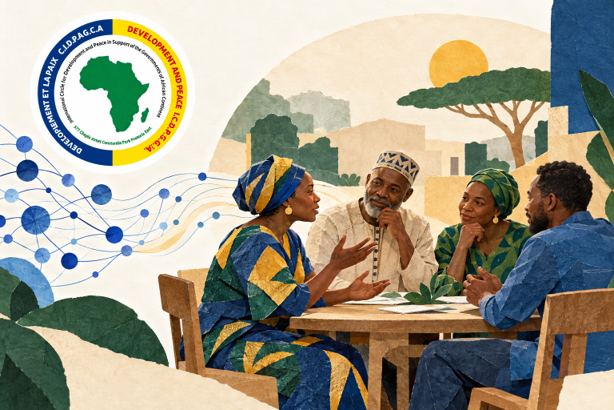
An early warning is useful when people can check it safely and someone has the means to respond. AI should strengthen that process while keeping judgement and accountability with people.
Executive summary
Artificial intelligence can help peacebuilders analyse information, identify patterns and organise wider consultations. Its value depends on how those capabilities are used. A forecast cannot establish what a community needs or decide which response is legitimate. For CIDPAGCA, the practical question is how technology can support research and dialogue while protecting the people whose lives may be affected by the resulting decisions.
What happens after a warning
When a system flags a rising risk of conflict, several questions need answers before anyone acts. What information produced the warning? Does it reflect what people are experiencing locally? Who can investigate without exposing those who raised concerns? Which institution has the authority and resources to respond?
Those questions connect technology to the work of prevention. A useful system must fit the relationships through which people report concerns and seek a response. The starting point should be the prevention problem and the people affected by it.
This leaves room for AI to contribute. It can help analysts work through large collections of information or compare patterns that would be difficult to examine manually. The responsibility for interpreting those patterns remains with the institutions and communities using them.
What the tools can contribute
Forecasting tools illustrate one possible role. The World Food Programme Innovation Accelerator’s Conflict Forecast project page describes a model using 10 million news articles to anticipate local conflict intensity. Such a tool may help direct analytical attention towards emerging risks. Its forecasts still require examination alongside local information and an account of the decisions they are intended to support.
Claims about predictive performance need care. A model’s confidence level and its rate of correct predictions are different measures. Reported results also depend on the event being predicted, the geographic area and the time horizon. Before relying on a headline percentage, a programme team should ask how the model was tested, how often it misses events and how often it raises an unnecessary alarm.
The more consequential the proposed response, the more important those questions become. A signal suitable for prioritising further research may be inadequate grounds for an intervention affecting people’s safety or access to services.
Digital dialogue can widen participation
AI can also support consultation. Martin Wählisch and Felix Kufus examine AI-assisted digital dialogues in a 2025 Data & Policy article. These platforms can help facilitators work with responses from large groups in real time. In Libya, UNSMIL reported a digital dialogue held on 16 October 2020, involving about 1,000 young participants from across the country and abroad.
That is evidence of an additional channel for participation. It does not tell us, by itself, how much influence participants had over subsequent decisions or whether the dialogue prevented violence. Those are separate questions for evaluation.
A digital consultation also needs an account of who could not take part. Organisers should examine connectivity, language, accessibility and the safety of expressing a view online. People excluded from the platform need another route into the discussion. Participants should hear how their contributions were considered, including where the eventual decision differed from what they proposed.
Simulations can explore possibilities
A 2024 background paper published through UNDP’s Human Development Report Office describes a Woolf Institute-led project using CulturePulse models to study conflict and cooperation in Northern Ireland, the Balkans and South Sudan. The project combined media analysis, stakeholder interviews and simulations.
These methods can help researchers examine how different assumptions affect possible outcomes. Their conclusions remain dependent on the data and behavioural rules built into the model. A simulation is an aid to questioning and preparation; people represented by it still need a voice in decisions that affect them.
For practitioners, the useful question is whether a simulation exposes an assumption that deserves investigation. It should make the reasoning easier to challenge, rather than giving a complicated model authority that its evidence has not earned.
Early warning needs a response pathway
In a June 2026 account of discussions at the Tanzania Peacekeeping Training Centre, UNDP Tanzania describes an idea for a multipurpose ICT centre combining community and institutional information. The account presents an opportunity for a pilot, not an established record of conflict-prevention results. Its emphasis on local ownership provides a useful basis for programme design.
Before commissioning a platform, partners should agree who receives an alert, who checks it and who can authorise an appropriate response. They should identify what resources are available and how information will return to the people who reported the concern. ECOWAS’s Guide to Joint Analysis and Response Planning provides a regional reference for connecting analysis with consultation and response planning.
Local verification should involve people able to question the interpretation of a signal. A model may identify a pattern, while those familiar with the setting can help establish what it means and what further information is needed. Disagreement should be recorded and investigated before an uncertain interpretation becomes the basis for action.
Trust has practical requirements
UNESCO’s Recommendation on the Ethics of Artificial Intelligence, adopted in 2021, places human rights and dignity at the centre of responsible AI. It includes privacy, fairness, accountability and human oversight. These principles have immediate implications for a peacebuilding programme.
Partners should collect only the information needed for a defined purpose and decide who may access it. Participants need a clear explanation of how their information will be used and what options they have if they decline to share it. Public reporting should avoid details that could identify someone who raised a sensitive concern.
Language and representation also require testing. A programme should ask whose experiences are well represented in its data, whose are missing, and whether users can challenge an interpretation. A local-language interface is useful only if the system and its reviewers can understand the meaning being conveyed.
Human oversight needs more than a person approving a screen. The responsible team must have enough knowledge, time and authority to question a recommendation or stop its use. Programme partners should also decide how errors will be recorded and corrected, and how affected people can raise a concern safely.
What donors and programme teams should test
A responsible pilot begins with a narrow prevention problem and a clear reason for using AI. It should be compared with the existing way of working, so that its contribution can be assessed. Possible measures include the time taken to verify a concern, false alarms and missed warnings, participation among groups previously excluded, and whether a verified concern received a timely response.
Those measures are steps towards learning. Counting alerts or consultation participants cannot establish that violence was prevented. Claims about prevention need an evaluation that considers other explanations and the practical limits of the evidence.
Funding should therefore cover verification and community engagement alongside the technology. Teams also need resources for staff training, independent challenge and follow-up. Where a tool creates risks that cannot be managed, partners should be prepared to change the design or stop the pilot.
A question for the next partnership
AI can support conflict prevention when it helps people understand concerns earlier and respond responsibly. Its usefulness has to be demonstrated in the setting where it will operate, with communities able to influence both the problem being addressed and the response.
For CIDPAGCA, that is a practical invitation to donors, researchers and community partners: begin with the prevention decision that needs support, then examine whether a digital tool can help. Contact CIDPAGCA to discuss the problem, the people who should shape the work, and the safeguards a partnership would need.
Sources
ECOWAS. Guide to Joint Analysis and Response Planning. Guide.
UN Support Mission in Libya. (2020, October 17). UNSMIL conducts the first-ever large-scale digital dialogue with 1000 Libyan youth online. Mission report.
UNDP Tanzania. (2026, June 29). From Early Warning to Early Action: How Technology Can Support Strengthening Community Resilience and Sustaining Peace in Tanzania. Programme discussion.
UNDP. (2024, December 5). Simulating Sustainable Societies: Uncertainty, Complexity and Multi-Agent Artificial Intelligence Modelling. Background paper.
UNESCO. (2021). Recommendation on the Ethics of Artificial Intelligence. Recommendation and principles.
Wählisch, M., and Kufus, F. (2025). Leveraging AI in peace processes: A framework for digital dialogues. Data & Policy. Article.
WFP Innovation Accelerator. Conflict Forecast. Project description.